
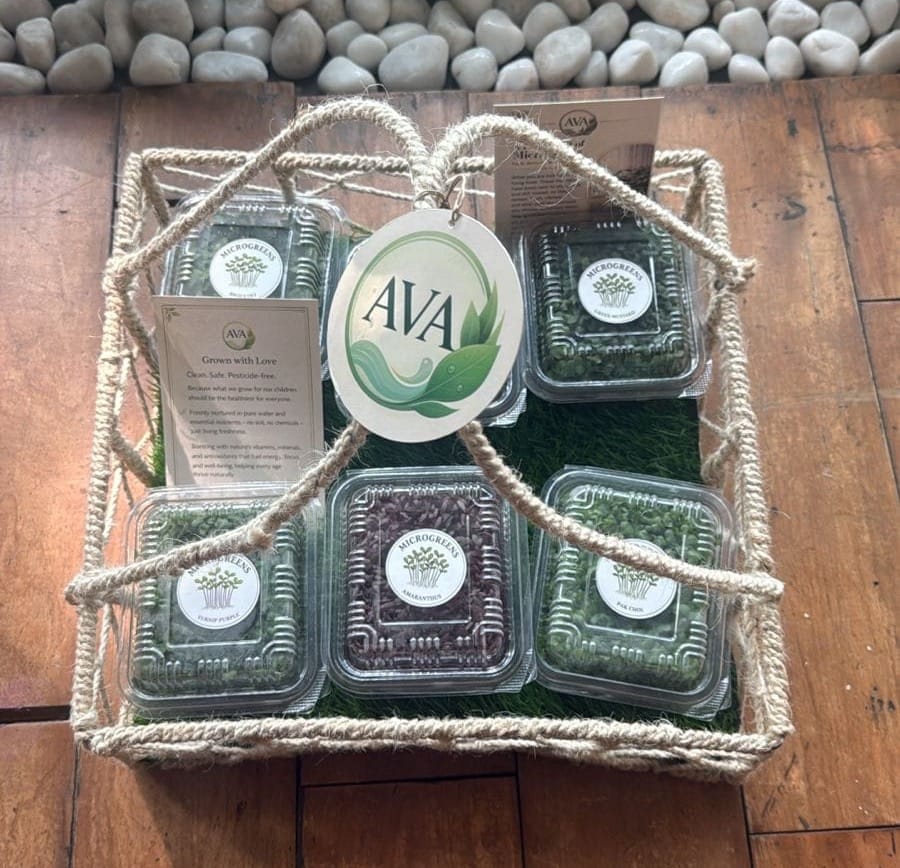
Yesterday, a good friend sent me a basket of micro greens. If you have ever seen micro greens, you might look at them as garnish. A handful of delicate, barely-there shoots that seem more decorative than meaningful.
Allow me to change that understanding.
Microgreens are seedlings harvested between seven and twenty-one days after germination.
Before the plant develops into its full form. At first glance, this seems like a disadvantage. You're eating the plant before it's ready.
But here is what actually happens at that stage of growth.
A seedling cannot protect itself the way a mature plant can. It cannot grow deeper roots to find water. It cannot spread wide to gather more light.
So instead, it does something remarkable. It concentrates. Every protective compound the plant produces, the antioxidants, the polyphenols, the fat-soluble vitamins, gets packed into those early leaves at maximum density.
The seedling defends itself chemically. You benefit from that defense.
Research comparing microgreens to their mature counterparts found that nutrient levels can be up to nine times higher in the younger plant.
Broccoli microgreens, specifically, contain sulforaphane precursors at concentrations ten to one hundred times greater than in mature broccoli.
Sulforaphane is the compound most studied for its role in activating your body's own cellular defense systems, including Nrf2, the pathway that regulates your response to oxidative stress.
This matters because oxidative stress is not just an abstract health concept. It is the mechanism behind accelerated ageing, chronic inflammation, and metabolic dysfunction.
The more efficiently your cells can neutralize it, the better they function over time.
A small portion added to a meal each day. A handful in a salad. A scoop into a smoothie.
The plant spent its most concentrated biological effort in those first two weeks. Make it a part of your everyday life.
Remember the size of what you ate was never the point. Nutrient density was.
NB: My friend Reshu Bansal has launched Ava Greens to help bridge gaps in your nutrition.

Ritesh Bawri
Founder, Nira Balance. Harvard Medical School (Physiology) & Tufts Medical School (Nutrition). Helping people reverse lifestyle diseases through first-principles health science.