


Most people think of meditation as something you add to life. A morning ritual. A ten-minute app session. A retreat you'll get to eventually.
Anapanasāti is something different.
It is not a practice you layer onto your day. It is an instruction manual for the one thing you are already doing. Twenty thousand times a day. Without choice.
Anapanasāti is Pali for mindfulness of breathing.
The Buddha described it in a single discourse that is, at its core, very simple.
You breathe in. You know you are breathing in. You breathe out. You know you are breathing out. That is the entire foundation.
But here is what modern neuroscience confirms about this ancient technique. Conscious attention to breathing activates the prefrontal cortex while simultaneously dampening the amygdala's threat response.
You are not just calming down. You are literally reorganising which part of your brain is in charge.
The rational, long-view steps forward. The reactive, alarm-driven part slows down.
This matters because the amygdala does not distinguish between a tiger and an email.
Both can register as threat. Both can trigger cortisol.
Anapanasāti interrupts that loop at the source. Not by escaping your circumstances but by changing who is observing them.
The practical entry point is simple.
Human beings tend to complicate things. You do not need silence. You do not need a cushion. Waiting at a traffic light. The thirty seconds before a difficult conversation.
The moment your child says something that tests your patience. These are not obstacles to practice.
They are the practice.
The breath is always happening in the present moment. Nowhere else. Which means every time you find it, you return to the present moment.
And the present moment, almost always, does not contain the thing you are anxious about.
You are not training yourself to breathe differently. You are training yourself to notice that you were never as far from stillness as you felt.
The anchor was there all along.
Practices such as these have become a part of my next book, Upekkhā: The Neuroscience of Strength & Serenity, which I hope to release this year.
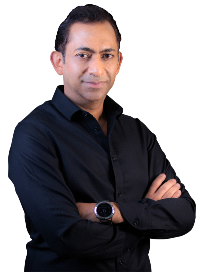
Ritesh Bawri
Founder, Nira Balance. Harvard Medical School (Physiology) & Tufts Medical School (Nutrition). Helping people reverse lifestyle diseases through first-principles health science.